 how-to
What Are the Best Tips for Selling a Home Fast?
Last Updated: October 25, 2026
Quick Summary
Selling a home fast starts with a realistic plan: price at or just below recent comparable sales to capture the heaviest buyer interest in the first two weeks, then stage and prep before you photograph. Homes listed between May and July sell in 40 to 43 days, while winter listings can sit for 53 to 59 days.
- Homes listed between May and July sell in 40 to 43 days, versus 53 to 59 days in winter.
- Pull recent comparable sales from the last 90 days, not last year, to set your price.
- Stage before you photograph, since photos are the listing and restaging means a second session.
- Skipping the pre-listing home inspection often costs more in negotiation than fixing issues upfront.
- Do not change the price and the photos in the same week, or you will not know which change worked.
Table of Contents
- Start With a Realistic Timeline: How Long Does It Take to Sell a House?
- How to Price a Home to Sell Quickly Without Leaving Money Behind
- Home Staging Tips for a Quick Sale That Buyers Notice
- Repairs, Cleaning, and Curb Appeal: The Prep Work That Pays Off
- Photography, Marketing, and Showings That Drive Buyer Demand
- When a Cash Offer for a House Makes Sense
- Comparing Offers Beyond the Headline Price
- Plan Your Sale With Jules Louisa Rick
- Frequently Asked Questions
Start With a Realistic Timeline: How Long Does It Take to Sell a House?
The honest answer is that most homes take weeks, not days, and selling a home fast starts with a realistic plan. According to Neighbors Bank's analysis of the best time to sell a house, homes listed between May and July sell in 40 to 43 days, while winter listings can sit for 53 to 59 days.
Selling a home fast starts with a realistic plan: set a target date, then work backward. A rushed listing usually costs money. A planned one sells faster and for more.
What Days on Market Actually Tell You
Days on market is the number of days a home stays listed before it goes under contract. It is the clearest signal of whether your price and presentation match buyer demand.
Watch it closely. A steady flow of showings with no offers points to price. No showings at all points to marketing or photos. We use that feedback loop to adjust fast.
How to Price a Home to Sell Quickly Without Leaving Money Behind
Competitive pricing is the single biggest lever for tips for selling home fast.
That early window is everything. Buyers and their agents watch new listings closely. An overpriced home misses that wave, then lingers while the market moves on.
A few pricing habits that work:
- Pull recent sales from the last 90 days, not last year
- Compare homes with the same square footage and condition
- Leave room for negotiation instead of building in a cushion
Watch out: overpricing "to leave room to negotiate" is a common mistake. It kills your best window and often leads to a price reduction anyway.
Reading Your Comparative Market Analysis
A comparative market analysis compares your home to similar properties that recently sold, are under contract, or are currently listed (Consumer Guide: What Goes Into Pricing Your Home).
Read it with local market conditions in mind. For a closer look at how values are calculated in a shifting market, see our guide on calculating home value in a fluctuating market.
Home Staging Tips for a Quick Sale That Buyers Notice
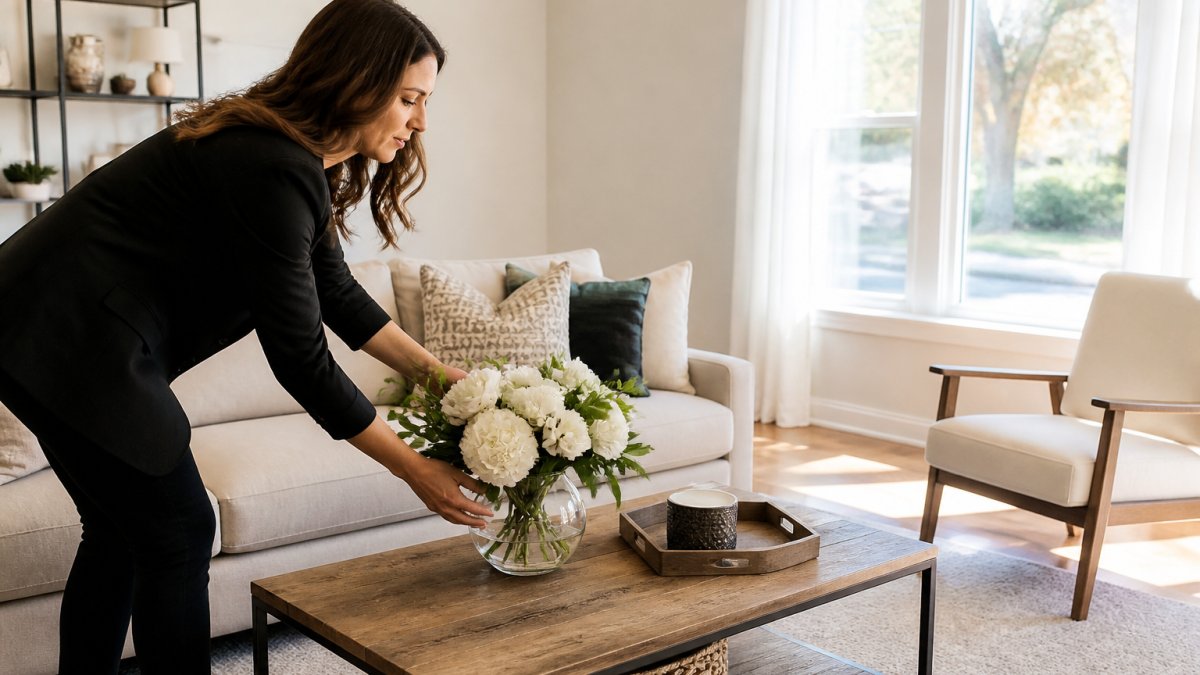
Home staging is preparing and styling a home so buyers see its best features immediately. Staged homes tend to sell faster and draw stronger offers, and staging is one of the highest-return prep steps you can take.
Stage the Rooms Buyers Judge First
Buyers form an opinion in the entryway and the main living space, then confirm it in the kitchen and primary bath. Spend your effort in that order, not evenly across the house.
- Entry and living room: clear the sightline from the front door, remove one large piece of furniture if the room feels tight, and angle seating toward the focal point (fireplace, window, or built-in).
- Kitchen: clear counters to one or two items, empty the sink, and remove personal appliances. Counters read as workspace, and empty counters read as more workspace.
- Primary bath: fresh white towels, a clear shower curtain, and a single scent-free candle. Remove medication, toiletries, and bath mats that look worn.
Occupied vs. Vacant: Two Different Playbooks
An occupied home needs depersonalizing and decluttering more than it needs furniture. A vacant home needs the opposite: buyers struggle to read scale and function in an empty room, so a light staging package (rented sofa, rug, dining set, and beds) usually pays for itself by preventing low offers driven by "it feels small."
- Occupied: pack personal photos, religious items, and collections before the first photo shoot. Aim to remove roughly a third of the furniture and half the surface clutter.
- Vacant: stage the entry, living room, primary bedroom, and one bathroom at minimum. Leave the rest empty and clean rather than half-furnished.
What Staging Actually Costs and How to Judge the Return
Staging costs vary widely by market and scope. A common pattern is a few hundred dollars for a consultation, low four figures for a partial staging of key rooms using existing furniture, and higher four figures per month for full vacant-home packages with rental furniture.
Judge the return the way an appraiser would: staging does not change square footage or condition, so it will not raise an appraisal above the comparable sales. What it can do is shorten days on market and reduce the chance of a price reduction.
The Small Touches That Still Work
- Fresh white towels in the bathrooms
- A bowl of fruit or fresh flowers on the table
- Warm lighting instead of harsh overhead bulbs
Then step back. If a room feels crowded, remove a piece of furniture. Space reads as value. Walk the home at the same time of day as your photos and again in the evening, because lighting changes what buyers notice.
Repairs, Cleaning, and Curb Appeal: The Prep Work That Pays Off
Curb appeal and basic repairs are the cheap fixes that protect your sale price.
Handle the small stuff first. Fix the dripping faucet, patch the nail holes, replace burnt-out bulbs. These are minor maintenance items, but they signal a well-kept home.
- Power-wash the driveway and walkway
- Trim overgrown bushes and mow the lawn
- Repaint the front door if it looks tired
Watch out: skipping the pre-listing home inspection can backfire. A surprise issue found during the buyer's inspection often costs more in negotiation than fixing it upfront.
Photography, Marketing, and Showings That Drive Buyer Demand
Professional photography and strong online exposure decide how many buyers ever see your home. Most buyers start their search online, so your listing photos are your first showing. The unique angle here is measurement: treat the first two weeks as a test, and use showing volume and offer activity to diagnose whether the problem is exposure, presentation, or price.
Get the Listing Presentation Right Before Day One
A listing is a set of fields buyers filter on, and weak fields hide the home from searches. Before you go live, confirm:
- Accurate square footage and room count so the home appears in the right filter results.
- A complete list of features (garage, basement, lot size, heating and cooling type, HOA details) because buyers search on these fields.
- A clear, specific headline that names the strongest feature rather than saying "must see."
Professional photos should be bright, wide, and honest. Poor phone photos shrink your audience before anyone books a visit, and misrepresenting the home in photos produces showings that end in disappointment and low offers.
Showings: Remove Friction and Track the Feedback
A flexible showing schedule removes friction for buyer inquiries. In practice that means lockbox access for buyer agents, a window that includes evenings and weekends, and a home that is showing-ready on short notice.
Then respond fast. Quick offer response time and prompt follow-up on buyer feedback keep momentum alive. A listing that goes quiet for a week loses buyer demand.
Use a simple feedback loop to diagnose the first two weeks:
- Strong online views, few showings: the photos or headline are not converting clicks into visits. Revisit the lead photo and the first three images.
- Many showings, no offers: buyers are arriving and rejecting the home in person. That usually points to condition, layout, or price relative to what they see inside.
- No showings at all: exposure or price. Confirm the listing is syndicated to the major portals and that the price is in line with active competition, not just recent sales.
Marketing Beyond the Listing Portal
Accurate listing details and wide online exposure do the heavy lifting, but a few low-cost additions widen the buyer pool: a floor plan in the listing, a short video walkthrough, and an agent who actively contacts buyer agents with matching clients. The goal is not more marketing channels for their own sake. It is more qualified showings in the first two weeks, when buyer attention is highest.
When a Cash Offer for a House Makes Sense
A cash offer for a house is a purchase made without a mortgage, which means no lender approval and a faster closing timeline. For sellers who need speed or certainty, that trade-off can be worth it.
Cash buyers often skip financing delays and may waive some contingencies. The catch is price. Cash offers sometimes come in below what a financed buyer would pay, so compare the net proceeds, not just the headline number.
| Situation | Cash Offer | Traditional Buyer |
|---|---|---|
| Closing speed | Faster | Slower, lender-dependent |
| Certainty | Higher | Lower |
| Likely price | Often lower | Often higher |
| Best for | Speed and simplicity | Maximizing sale price |
Comparing Offers Beyond the Headline Price
The highest offer is not always the best offer. Offer terms matter just as much as the number on the page.
Compare offers on four things: price, financing strength, contingencies, and closing timeline. A slightly lower offer with solid financing and few contingencies can beat a higher one that risks falling apart.
- Is the buyer pre-approved or just pre-qualified?
- How large is the down payment?
- Are there inspection or appraisal contingencies?
Multiple offers give you use, but only if you read them carefully. Negotiation is about net proceeds and certainty, not ego.
Plan Your Sale With Jules Louisa Rick
Selling a home fast without leaving money on the table takes a plan, and that is where good guidance pays off. Jules Louisa Rick helps sellers price with data, prep with purpose, and negotiate offers that protect their bottom line.
Before you list, get a clear valuation so your first number is your best number. Our step-by-step guide on how to value my home walks you through it. And when you are ready to move, see how we make your move, made simple for sellers across Middle Tennessee.
From our happy homeowners, you can read real stories from past clients and see the results for yourself. When you are ready to talk, let's start the conversation about your sale.
Frequently Asked Questions
What is the hardest month to sell a home?
Winter tends to be the slowest stretch. Homes listed between May and July sell in 40 to 43 days, while winter listings may sit on the market for 53 to 59 days, according to Neighbors Bank data. That does not mean a winter sale is a bad idea. Fewer competing listings can work in your favor if your home shows well and is priced correctly. Selling a home fast in any season comes down to preparation, pricing, and marketing rather than the calendar alone.
Does staging a home help it sell faster?
Staging gives buyers a clear picture of how each room functions, and that shortens the time they spend deciding. Staged homes can sell faster and draw stronger offers. Focus on the rooms buyers weigh most: the entry, living room, kitchen, and primary bedroom. Removing personal items and excess furniture makes rooms look larger in photos and in person.
Should I lower my asking price to sell my home quickly?
A price reduction works when the data supports it, not as a first reflex. Review your comparative market analysis and recent days on market before cutting. If showings are steady but offers are not, the issue may be condition or presentation. If showings are scarce, price is usually the culprit. A measured reduction early often costs less than a large cut after months of stale listing time.
Is a cash offer the fastest way to sell a home?
A cash offer for a house can close faster because there is no lender financing to wait on, and inspections or repairs may be negotiated differently. The trade-off is that cash buyers often expect a discount in exchange for speed and certainty. Compare the net proceeds of a cash offer against what a financed buyer would likely pay after repairs, concessions, and closing costs.
Selling a home fast is a balance of speed and price, and the right strategy protects both. Jules Louisa Rick brings 12 years of experience, certified short sale and military relocation expertise, and strategic negotiation to every listing. We help you price right, prepare well, and close with confidence. Get started with Jules Louisa Rick and turn your listing into a sale that works for you.